POINT TO LINE TO PLANE
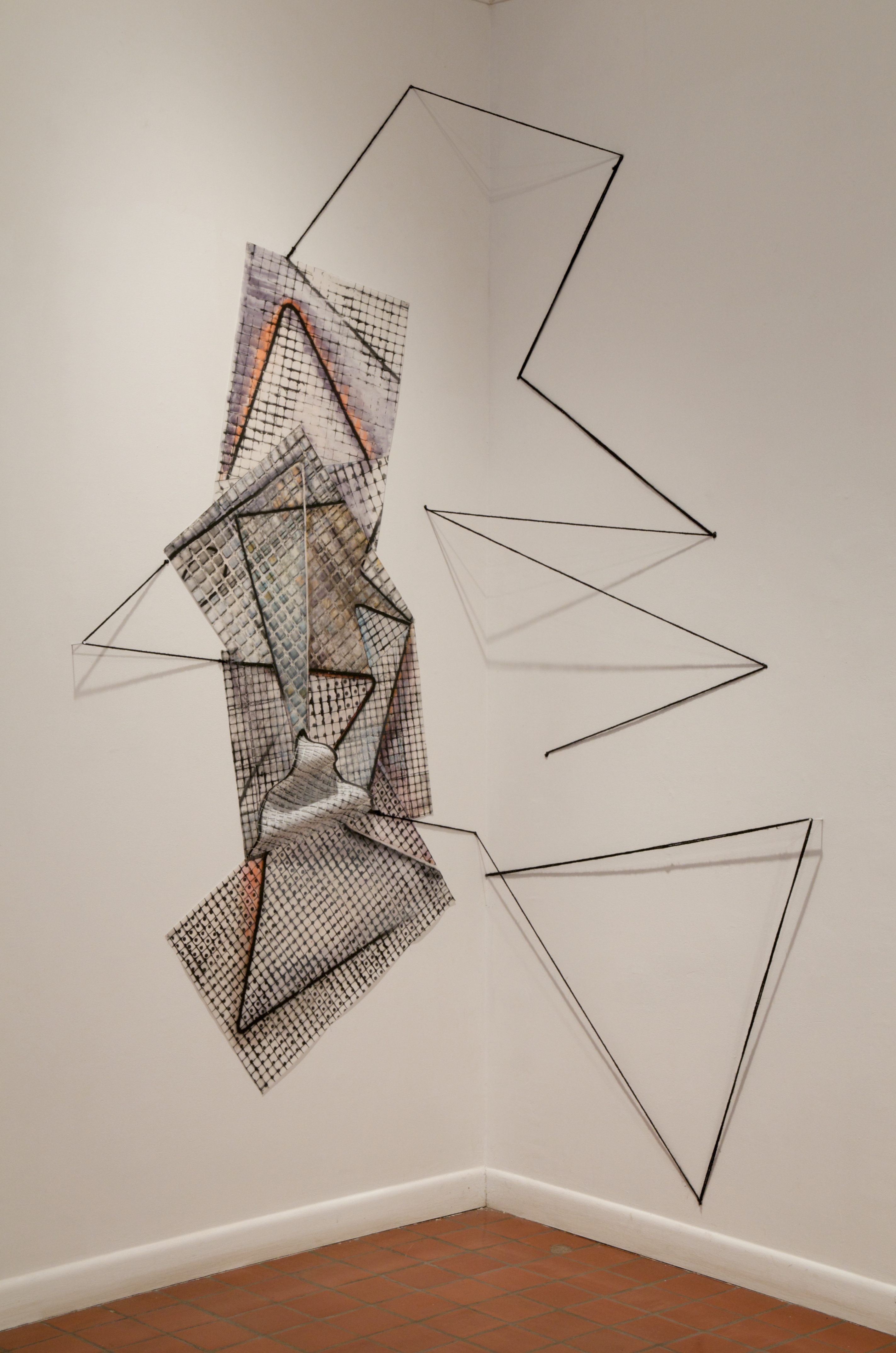 Barbara Garber’s oeuvre is a sustained meditation on the art of drawing. For more than twenty years, exploring how point is attenuated to fine and line expands to plane has anchored her artistic practice. She works in the tradition of the early Moderns but informed by sources as varied as Italian frescos and improvisational music and dance.
Alongside a series of two-dimensional wall pieces, she creates three-dimensional installations. These dynamic works are immersive experiences — their theatricality often heightened by soundscapes. Garber fluidly mixes art materials with mundane materials such as string, wire, aluminum, netting, screens, and snow fencing. Early monoprints, frequently pressed from these very items, echoed and amplified their source materials. In her newest work, she creates form by hand-stenciling color through these same vernacular materials. Veils of pigment adhere delicately to the Mylar ground. Where earlier work had an up-tempo jazzy quality, this work is more restrained. It explores incremental shifts in tone and form accented with flashes of color.
Garber’s art is dominated by opposing forces. A sinuous biomorphic shape courses through a starkly geometric space. Patterns appear as melodic or syncopated. Interlocking planes spin with centrifugal force. Space layered with subtle tints collides with passages of saturated color. Her placement never privileges the fine art over the pedestrian. The effect is extemporaneous and non-hierarchical. A piece can be experienced as harmonious or as discordant. In each, Garber weaves complex rhythmic structures into a sustained whole. The viewing experience is full-bodied, dynamic, exhilarating.
-Mara Williams, Chief Curator
Brattleboro Museum & Art Center
FREEFALL
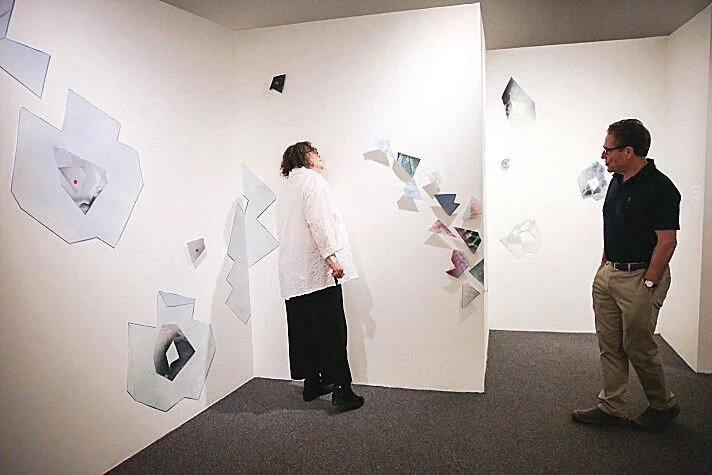
BRATTLEBORO — The exhibit of Barbara Garber’s paintings is in its final week at the Brattleboro Museum. It is work of quiet intensityandremarkable originality.
When I walk into the gallery where her works are displayed, I feel the atmosphere in the museum change. I shift gears. These pictures seem to have been breathed onto the walls. To try to name that particular quality, I think of being touched by a song. A song has its word content, itstune, a singer clear and on pitch but what pulls at the heartstrings above all is that slighthesitation, that catch in the voice of that one special singer.
Garber’s art feels like the visual equivalent of that. There is a sense of being admitted into her private thoughts.
Thoughts about what? Ahhhh nothing much? Everything? Perhaps about the sensation of being a state endlessly rich, but so fragile. The anomaly in this show is the one purely abstract work, a “scatter” piece on four adjacent walls, which may serve as an introduction to the sensation of balancing on an edge between existence and non-existence that characterizes Garber’s art. To see this as a traditional composition is impossible. Its organization is attenuated, hidden around corners, to be experienced in the mind, but not in the eye.
The rest of the show, small format pictures, are unmistakably based on looking at stuff … or perhaps on a reverie on the experience of looking at stuff. She seems to play with the basic idea of art making.
“Play” is such a multi-function word: One uses it in the sense of playing the piano, serious business. Then there is the play of children, free, imaginative, unfettered. There is “my car’s steering has some play in it.” here meaning “not well fixed, in a loose relationship.” Hold all three in your head at once and you may get a foothold on Garber’s sense of play; tongue-in-cheek and serious at the same time.
This is not minimalist art … she dives into the marvelous conventions handed down to us from the Renaissance, deftly using the tools of depicting objects in space — overlap, perspective, pattern, light and shade — with grace, and even glee. They are pictures, in the sense that something is going on, something “other” is being illustrated. What that might be remains her secret.
The point of it all is not in what she says, but the way that she says it. The meaning is in the gaps.
-David Rohn, Artist
Drawing Closer
Inherent in this series of drawings is an exquisite tension. This tension is not edgy, but rather sublime in its poetic arbitration of the dual functions of thought… the subliminal thought of the intuitive that’s ineffable, and the structured thought of reason that has to make sense of everything.
The process of working with collaged, painted transparent layers of Mylar offers an ideal medium in which to try to arbitrate this dual function of thought. The translucency of the layers allows beautiful colors to be mixed, shapes to be formed, and all is animated by expressive and elegant lines.
To this viewer, these drawings are about the activity of their making: being as rationally articulate as one can be about the ineffable. The results of this activity are these beautiful drawings of an exquisite tension.
-Bill Ramage, Artist